
Aging Inventory in Hardware Manufacturing: Causes, Costs, and AI-Powered Solutions
Aging inventory drains cash in manufacturing. Discover the causes and how AI solutions help hardware manufacturers cut waste and stay competitive.
SUPPLY CHAIN AI
1/31/20263 min read
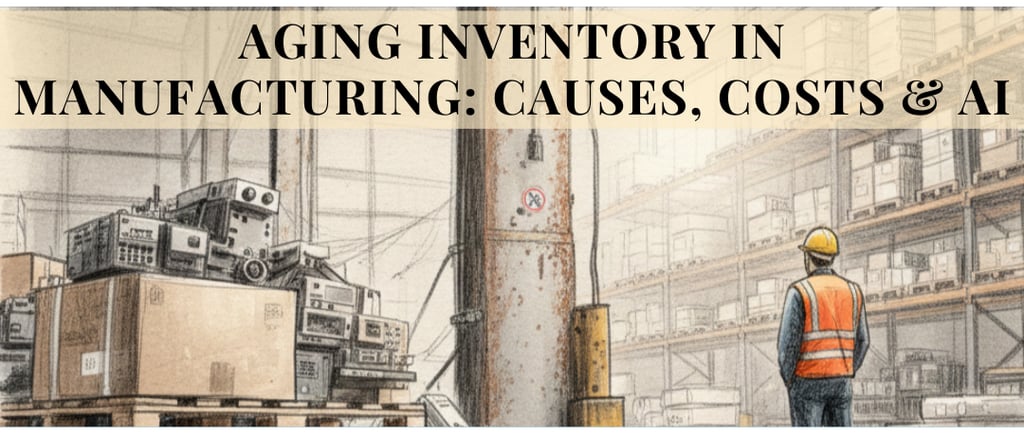
Aging inventory is a silent profit killer in hardware manufacturing, where long product life cycles, complex bills‑of‑material (BOM), and capital intensive equipments collide with volatile demand. When raw‑material bins, WIP, and finished‑goods sit idle for months, they non only just tie up working capital but also increase obsolescence risk, storage costs, and quality related write offs.
In manufacturing, “aging inventory” refers to items that remain unsold or unused beyond their expected turnover window, often grouped into buckets like 30/60/90/120+ days. For hardware manufacturers, this includes raw materials (e.g., machined castings, PCBs, connectors), sub‑assemblies, and finished machines or components.
Why Aging Inventory Matters
In industries that deal with silicon chips, precision machined parts, or custom hardware modules, excess inventory turns into technical and financial burden:
Obsolescence: Electronic components become outdated quickly due to rapid technological advances.
Degradation: Batteries, adhesives, elastomers and other chemical components deteriorate over time.
Carrying costs: Warehousing, insurance, capital costs, and potential rework add up.
Cash flow impact: Funds tied up in stagnant stock reduce agility to respond to market demand.
Main Causes of Aging Inventory in Hardware Manufacturing
1. Demand Forecasting Errors
Traditional forecasting methods (e.g., simple moving averages, rule‑of‑thumb safety stocks) often fail to capture nonlinear demand patterns, seasonality, and order‑pattern shifts from OEMs and distributors. When forecasts overestimate demand, manufacturers build excess finished‑goods and raw‑material buffers that sit idle without generating any cash.
2. Long Lead Times and Bullwhip Effect
Hardware manufacturing often relies on long‑lead components (e.g., custom castings, specialty bearings, electronics module) and complex multi‑echelon supply chains. When Material Requirements Planning (MRP) systems use fixed lead‑time assumptions and static reorder points, they tend to “push” inventory into the system ahead of uncertain demand, creating aging buffers. When combined with poor communication across tiers, this creates the bullwhip effect, where small changes in demand get amplified upstream, leading to over ordering and excess stock.
3. Poor Visibility Across Multi-Tier Supply Chains
Modern hardware supply chains are complex and global. Components for a single product may come from multiple continents. Many manufacturers still rely on spreadsheets or legacy ERP modules that lack real‑time visibility into bin‑level stock, lot ages, and usage velocity. Without robust ABC‑XYZ or fast‑/slow‑/non‑moving segmentation, planners cannot distinguish between healthy safety stock and true aging inventory. This lack of visibility leads to risk-averse ordering which increases aging inventory.
4. Product Lifecycle Mismatches
Even in traditionally “slow‑moving” industrial hardware, product‑life cycles are shortening due to automation, connectivity, and regulatory changes (e.g., energy‑efficiency standards). Older models and their associated components quickly lose value when newer, more efficient versions enter the market.
This is particularly widespread in electromechanical and electronics‑integrated hardware, where component obsolescence (e.g., discontinued ICs, legacy connectors) can strand entire sub‑assemblies.
Artificial Intelligence (AI) is not a magic wand, but when applied strategically, it transforms inventory management from reactive guessing to predictive precision. AI and machine learning offer a data‑driven way to shrink aging inventory while maintaining service levels, especially in hardware manufacturing with complex, multi‑echelon networks.
1. AI-Driven Demand Forecasting
Unlike traditional forecasting, AI models (e.g., recurrent neural networks, gradient boosted forests) can ingest multiple data streams e.g. sales history, market signals, supplier performance, macroeconomic indicators and learn patterns that a human can miss.
Benefits:
More accurate demand predictions, even during volatility
Dynamic updating as new data arrives
Scenario analysis for market shifts
2. Predictive Lead Time Modeling
Variability in supplier lead times is a core driver of excess inventory. AI can model lead time distributions based on real data rather than assumptions, enabling planners to:
Adjust safety stock dynamically
Identify suppliers with unreliable delivery patterns
Minimize unnecessary buffer stock
3. Real-Time Inventory Optimization
AI can integrate with Enterprise Resource Planning (ERP) and Warehouse Management Systems (WMS) to:
Continuously assess stock aging
Flag slow movers vs fast movers
Suggest automated actions (e.g., reduce reorders, redistribute stock across locations)
Modern approaches use reinforcement learning algorithms that optimize inventory policies for multiple objectives simultaneously (service level, cash flow, warehouse utilization).
4. AI-Enabled Product Lifecycle Synchronization
AI can ingest PLM data, sales forecasts, and inventory status to recommend:
When to ramp down orders for components tied to declining products
How to reallocate stock to newer product lines
When to liquidate obsolete parts to minimize losses
By embracing AI across forecasting, optimization, and product lifecycle planning, manufacturers can turn inventory from a liability into an agile asset to support innovation and market success.