
The Digital Machinist: How AI is Transforming CNC Programming in Modern Manufacturing
Discover how AI optimizes CNC programming to reduce cycle times, improve precision, lower costs, and boost manufacturing efficiency and productivity.
MANUFACTURING AI
2/16/20262 min read
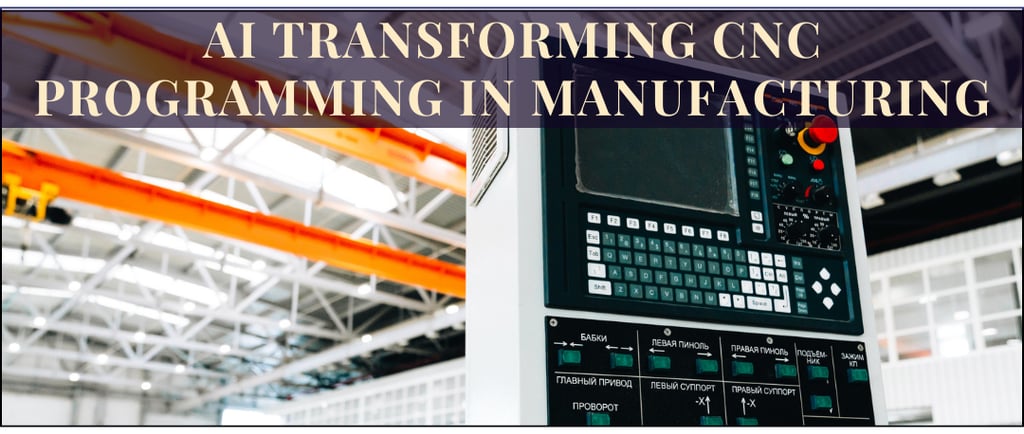
For decades, Computer Numerical Control (CNC) machining has been the backbone of manufacturing. But the process of moving from a digital design to a finished physical part and programming the machine for transforming a raw material to finished product, has historically been a bottleneck. It required highly skilled programmers to manually define toolpaths, speeds, and feeds, often leading to long lead times and room for human error.
The Traditional Challenge of CNC Programming
Writing efficient CNC programs has always required:
Deep knowledge of machining strategies
Careful toolpath planning
Manual optimization of feeds and speeds
Experience-based decision-making
Even with advanced CAM software like Mastercam, Siemens NX, and Fusion 360, programmers still rely heavily on expertise and trial-and-error to achieve optimal performance.
This leads to challenges such as:
Long programming times
Inconsistent quality across programmers
Suboptimal machining parameters
Higher scrap and tool wear
AI can address many of these challenges with guidance from subject matter experts.
Contact us to leverage our expertise in machining processes improvement.
Where AI Fits in the CNC Programming Workflow
CAD/CAM feature recognition and strategy selection
AI models can automatically recognize the geometrical features like holes, pockets, slots, and freeform surfaces in CAD, and map them to machining strategies (drill, pocket, 3D surfacing, etc.).
Some of the existing CAM software providers already using AI to propose toolpaths for 3-axis and 5-axis machines with minimal manual setup.
Automatic toolpath and G‑code generation
AI‑driven CAM engines can generate roughing and finishing toolpaths directly from the model, then output verified G‑code in a single flow.
Large language models integrated with CAD/CAM can translate design intent and process constraints into optimized G‑code, considering material, machine limits, and surface finish requirements.
Copilots and conversational programming
CAM “copilots” already embedded in few CAD/CAM platforms which let programmers ask natural‑language questions (“Suggest a strategy for this pocket in 6061 Aluminum”) and get several process options back.
These copilots guide users through tool selection, operation ordering, and parameter tuning, acting like an interactive tutor for less‑experienced programmers.
Parameter optimization (feeds, speeds, step‑over)
AI can learn from historical jobs, cutting data, and tool‑vendor recommendations to suggest feeds, speeds, and step‑overs that balance cycle time, surface quality, and tool life.
Over time, the system can tailor its recommendations to each shop’s machines, tooling, and risk profile.
Real‑time adaptation and closed‑loop machining
AI‑enabled CNC controllers can monitor spindle load, vibration, temperature, and tool wear, then adjust the G‑code on the fly to avoid chatter, collisions, or tool breakage.
Multi‑agent systems like ChatCNC show how LLMs can be fused with live telemetry so operators can query machine status (“What caused that spike at 09:32?”) and get the readable answers.
Knowledge capture and standardization
AI systems can learn from the shop’s past NC programs, setups, and corrective edits, turning tribal knowledge into reusable templates.
That knowledge is then applied consistently across families of parts, improving standardization and reducing variability between programmers.
Role of Human Experts
While AI can automate the mundane aspects of programming, it is not replacing the need for skilled machinists. Instead, it is empowering them.
Experienced process engineers curate “approved” strategies and guardrails.
AI handles feature recognition, template selection, and baseline parameter suggestions.
Humans do risk analysis (PFMEA), special/key characteristic features, safety critical surfaces, and final sign‑offs.
By handling the complex calculations and data analysis, AI frees up human programmers to focus on higher-level strategy, fixture design, and process optimization. The future of manufacturing is a hybrid one: human expertise combined with AI efficiency.
Contact us to leverage our expertise in machining processes improvement.