
AI in Manufacturing
Why AI adoption in manufacturing is slower than expected and what actually works to overcome data, process, and change-management barriers.
1/4/20264 min read
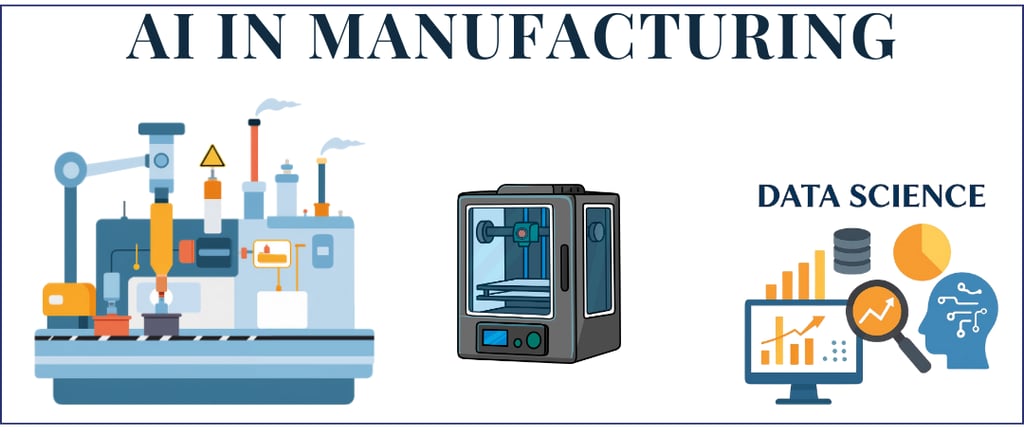
Artificial Intelligence (AI) and Machine Learning (ML) have demonstrated their value across industries, but manufacturing has adopted them at a noticeably slower rate. This isn't due to a lack of creativity or ambition. Manufacturing environments continue to be complex, risk-sensitive, and centered on physical systems that prioritize reliability over speed. It is critical that new technologies in this space coexist with long-lasting assets, rigorous safety standards, and finely tuned processes. As a result, AI adoption is more deliberate and incremental, with an emphasis on proven value rather than experimentation for its own sake.
If you’re evaluating use cases, stuck at the pilot stage, or thinking about scaling AI across plants, reach out to us at info@dimensionalanalytics.com
Manufacturing is at the intersection of operational expertise and advanced analytics, and new AI capabilities must be compatible with both. This alignment requires time, coordination, and trust among teams, which naturally slows the path from idea to impact.
As initiatives progress from strategy to execution, deeper structural challenges emerge.
Where AI Implementation Becomes Difficult
1. Limited Talent at the Intersection of AI and Manufacturing
AI in manufacturing requires more than technical skill or domain experience alone, it requires both. Generalist data scientists may be strong in modeling and analytics but unfamiliar with production constraints, equipment behavior, or plant operations. Similarly, manufacturing experts deeply understand processes but may not be trained in data-driven methods to implement AI into the system. This gap is structural, not individual. Talent that understands both AI and manufacturing systems is still emerging, and organizations often need time to build cross-functional teams, shared language, and collaborative workflows before AI can be effectively deployed.
2. Data Exists, but It Isn’t AI-Ready
Manufacturing produces massive amounts of data, but it is rarely organized for analytics. Data is distributed across machines, sensors, historians, MES, ERP systems, quality tools, and manual logs, all of which are designed for successful operations rather than machine learning and analytics.
Before AI can provide value, teams must standardize signals, align timestamps, clean up inconsistencies, and assign data ownership. This foundational work frequently takes longer than model development itself.
3. Lack of Operational Context Limits Learning
Manufacturing results are rarely explained by raw data alone. Contextual information is frequently absent or inconsistently recorded, including maintenance events, tooling modifications, material quality, shift patterns, and operator interventions.
AI models' capacity to generalize across time or plants is hampered by their inability to discern between meaningful signals and normal variation in the absence of this context.
4. Integration Is More Challenging Than Modeling
Stability and uptime are prioritized in most of the manufacturing systems. It takes careful planning and testing to incorporate AI into MES, ERP, SCADA, and quality workflows.
Decisions are rarely influenced by insights that are too late, exist outside of operational tools, or necessitate extra manual steps, due to which the main bottleneck is often integration of AI tools and methodology into the system rather than model accuracy.
5. Trust and Explainability Are Critical
Decisions made on the factory floor affect delivery promises, quality, and safety. To gain trust, AI recommendations need to be consistent and easy to understand.
Regardless of their statistical performance, black-box models that are difficult to understand or validate are frequently ignored. Confidence, not novelty, is what determines adoption.
6. Scaling Beyond Pilots Is Non-Linear
Many manufacturers have successfully deployed AI pilots, however, scaling them across lines, plants, or regions causes variation in equipment, processes, data quality, and operating conditions. Without strong governance, monitoring, and retraining strategies, model performance deteriorates quietly. To scale AI in manufacturing, systems must be designed for variation rather than one-time solutions.
7. Change Management Is Often Undervalued
AI introduces new decision-making dynamics. Operators, engineers, and planners must understand when to rely on AI and when to override it. Without training, ownership, and clear accountability, AI remains an external tool rather than an embedded capability.
What Successful Adopters Do Differently !
Manufacturers that succeed with AI don’t move faster- they move smarter. They start with specific, high-impact operational problems, not abstract AI ambitions. Predictive maintenance, quality inspection, and production optimization are approached as business challenges first, analytics problems second.
They invest early in data foundations, treating data engineering, governance, and context capture as core capabilities rather than supporting tasks.
They design AI to fit existing workflows, embedding insights directly into systems operators already use, rather than introducing parallel dashboards.
They prioritize explainability and trust, ensuring recommendations are transparent, testable, and aligned with domain expertise.
They plan for scale from the beginning, accounting for variation across plants, equipment, and processes, and building monitoring and retraining into the system.
Most importantly, they treat AI as a long-term operational capability, not a one-time project.
The Bottom Line
AI adoption in manufacturing is slow by design, because the industry places a premium on safety, dependability, and consistency and new technologies must demonstrate their worth in real-world manufacturing applications.
This discipline is not a weakness; it distinguishes between long-term, production-grade AI and short-lived experiments, making AI useful for manufacturing teams rather than a liability to maintain. Manufacturers who understand the complexities of their operations, invest in strong foundations, and focus relentlessly on execution will win with AI.
Ready to Move from Exploration to Execution?
If you’re curious about how AI, data science, and analytics can be practically implemented in manufacturing and other non-software industries, we’d be happy to talk.
We specialize in applying AI where systems are physical, data is messy, and reliability matters—bridging the gap between advanced analytics and real-world operations.
If you’re evaluating use cases, stuck at the pilot stage, or thinking about scaling AI across plants, reach out to us at info@dimensionalanalytics.com
Let’s turn complexity into clarity.