
Build-to-Print vs. Build-to-Specification: The Data Science Advantage in Manufacturing Risk Assessment
A comparison of Build-to-Print (BTP) and Build-to-Specification (BTS), highlighting when to use each model and how data science enhances quality control, optimization, and decision-making.
SUPPLY CHAIN AI
2/12/20262 min read
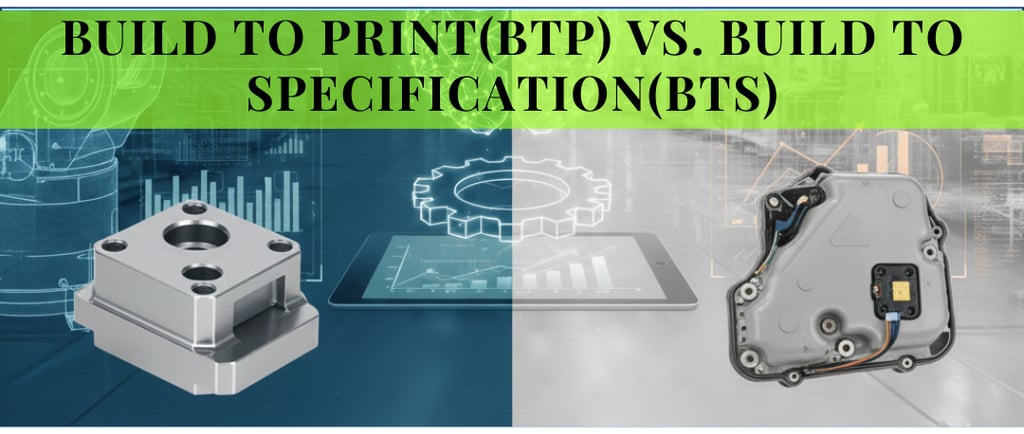
In modern manufacturing, companies often choose between build‑to‑print (BTP) and build‑to‑specification (BTS) models to outsource production. Both approaches serve different business needs. By understanding their differences and leveraging data science, manufacturers can make faster and smarter decisions with reduced risks.
What build‑to‑print and build‑to‑spec mean
Build‑to‑print (BTP) means the customer provides fully detailed engineering drawings, material specs, tolerances, and process instructions; the manufacturer’s job is to replicate the design exactly without changing the core design intent.
Build‑to‑specification (BTS) means the customer defines functional requirements and performance parameters (size, load, temperature, etc.), and the manufacturer chooses how to design and fabricate the part within those constraints.
In short:
BTP = “here is the blueprint; build it this way.”
BTS = “here is what it must do; you decide how to build it.”
Contact us to leverage our 10 plus years of expertise in evaluating sourcing options for manufacturing and strategic sourcing of hardware commodities.
Key differences between BTP and BTS
BTP is ideal when the design is mature, IP must stay in‑house, or you need exact replication (e.g., spares, legacy parts).
BTS fits when the customer lacks design capacity, wants cost‑optimized solutions, or needs the supplier’s process expertise.
How data science helps in build‑to‑print
In BTP, most variability comes from process execution, not design, so data science focuses on predictability and consistency:
Process‑variation analytics
Use sensor and machine data to detect subtle deviations in dimensions, cycle times, or tool wear that correlate with out‑of‑tolerance parts.Predictive quality and defect reduction
Machine‑learning models on inspection and test data can predict defect rates per lot, enabling real‑time interventions instead of post‑production scrap.Supplier‑performance scoring
Aggregate data on yield, on‑time delivery, and rework rates across BTP programs to rank suppliers and guide sourcing decisions.
In practice, data science turns BTP from a “follow the print” mindset into a data‑driven quality loop, where decisions about tooling, maintenance, and lot‑sizing are based on evidence rather than intuition.
How data science helps in build‑to‑specification
In BTS, the main challenge is exploring design flexibility and process options while staying within constraints, so data science supports optimization and trade‑off analysis:
Design‑of‑experiments (DoE) and surrogate models
Use historical BTS projects to build predictive models of how material choice, wall thickness, or heat‑treatment affect strength, weight, and cost.
This lets engineers quickly evaluate dozens of “what‑if” designs without physical prototyping.Cost‑performance optimization
Combine similar existing products based on function, technology, material prices, and machine‑hour costs into an optimization model that suggests the lowest‑cost configuration that still meets the spec.Risk‑informed quoting
Use past BTS projects to estimate the probability of redesigns, late‑stage changes, or performance failures, then factor that risk into pricing and lead‑time estimates.
With data science, BTS becomes less about guesswork and more about evidence‑based design exploration, helping manufacturers choose the right architecture and process faster.
Contact us to leverage our 10 plus years of expertise in evaluating sourcing options for manufacturing and strategic sourcing of hardware commodities.